
Gender norms, violence and social change
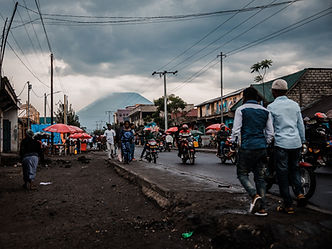
Between 2021 and 2022, I spent eleven months embedded with the Congolese NGO Ghovodi in Goma, North Kivu, observing and documenting the Washindi gender-transformative programme as it unfolded. I documented how Congolese men, women, and young people engaged with, resisted, and gradually transformed their understanding of gender and violence. The five findings below capture the core contributions of that work.
Since then, I have continued to build on this work — expanding the Washindi approach across sectors (including nutrition, maternal health, livelihoods, and social cohesion), applying lessons from the DRC to new contexts including civilian and veteran engagement in Ukraine, and developing more rigorous, participatory approaches to measuring social change.
1. Men are not just perpetrators; they are also victims.
In eastern DRC, men experience significant economic, physical, and psychological violence in their daily lives — yet GBV prevention programmes rarely acknowledge this. By focusing almost exclusively on men as perpetrators of violence against women, interventions risk missing the broader systemic nature of violence that affects everyone in conflict-affected settings. My research showed that men's frustration at feeling unheard — at having their own experiences of suffering, loss, and powerlessness ignored — is a significant driver of resistance to gender-transformative programming. This doesn't mean deprioritising women's needs or diminishing male responsibility for violence. It means that in contexts of everyday violence, where poverty, conflict, and trauma shape everyone's lives, a more intersectional approach — one that takes men's suffering seriously alongside women's — is likely to produce more sustainable change. The challenge is to hold both realities at once.


2. Gender norms are not fixed traditions; they are contested social processes.
One of the most important findings from my fieldwork was that norms are far more fluid and contested than they appear from the outside — or than participants themselves initially described them. People in Goma are simultaneously exposed to customary rules, religious teachings, Congolese law, NGO campaigns, and global media — all offering different and sometimes contradictory ideas about what gender relations should look like. They exercise real agency in navigating these competing frameworks, choosing which to follow depending on the situation, the people involved, and what they stand to gain or lose. This means that change is more possible than fatalistic narratives of "culture" suggest — but it also means that the relationship between norms and behaviour is not straightforward. People may express agreement with new ideas in a group setting while continuing to act differently at home. Understanding which norms people are willing to challenge, under what conditions, and at what cost, is essential for designing effective interventions.
3. Change requires legitimacy, not just information.
Most gender-transformative programmes rest on a simple assumption: better information leads to attitude change, which leads to behaviour change. My research found this sequence inadequate. Norms are not individual beliefs — they are social contracts. People act in certain ways because they expect others to as well, and deviation carries real costs. Individual willingness to change, however genuine, is therefore not sufficient on its own. What actually shifts behaviour is a collective sense that new ways of thinking and acting are legitimate — socially acceptable within the group. The Washindi groups worked not because they delivered the right content, but because they created conditions for collective deliberation and consensus-building. Participants argued, questioned, and gradually convinced each other. The group became its own reference point — one where new expectations took root and where people held each other accountable. The quality of the group process, it turns out, matters as much as what is written in the curriculum.

4. Social sanctions are an invisible barrier, and a serious safeguarding gap
When participants began to adopt new behaviours outside the group, many faced real social costs — ridicule, hostility from relatives, pressure from spouses. These sanctions are well-documented yet almost never addressed in programme design. My research showed that NGOs may unwittingly cause harm by encouraging change without preparing people to manage the social consequences. Crucially, the discussion groups themselves functioned as new reference networks — providing counter-legitimacy that helped participants withstand sanctions from their existing communities. Strong, sustained peer groups are not a nice-to-have in gender-transformative programming — they are a safeguarding necessity.
5. Standard measurement tools cannot capture social change
The dominant evaluation paradigm in GBV prevention — standardised surveys, attitude scales, and randomised controlled trials — is poorly designed for the kind of change these programmes are trying to produce. Social norms change is complex, non-linear, and deeply contextual. It unfolds over years, not months, and is shaped by structural factors no intervention controls for. Quantitative tools can tell you whether attitudes shifted between baseline and endline — but not whether the shift is real or performative, what drove it, or what will sustain it. My research showed empirically how much of what mattered in the Washindi groups was invisible to standard measures. This is not just a methodological observation — it has serious consequences for funding, accountability, and the field's ability to learn. This gap is at the heart of my current research agenda on participatory measurement and community-defined indicators of change.
